Sn2 Vinyllic Halide

Determine Based On The Identity Of The Substrate Nucleophile And Solvent The Mechanism Of Nucleophilic Substitution Of Chemistry Organic Chemistry Sn1 Sn2

Alkyl Halides Organo Halogen Alkyl Halide Aryl Halide Halide Vynilik Intermolecular Force Hydrogen Bond Pi Bond
Why Is Vinyl Halide Inert Towards Both Sn And Sn Reactions Quora

Alkyne Hydrohalogenation Follows The Markovnikov S Rule Chemistry Organic Chemistry Inductive Effect
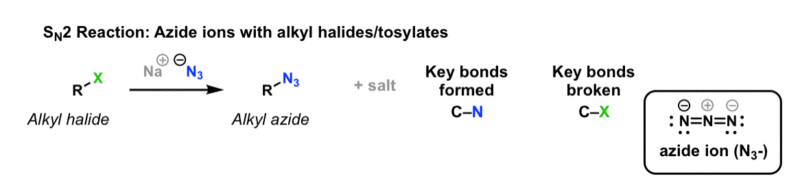
Sn2 Reaction Between Azide Ion And Alkyl Halides To Give Alkyl Azides Master Organic Chemistry

Why Benzyl Chloride Is Highly Reactive In Sn1 Reaction In Spite Of Primary Alkyl Halide Chemsolve Net Green Chemistry Dissociation Reactions

Why do allylic halides prefer sn2 reaction over sn1.
Sn2 vinyllic halide. The resultant vinylic carbocations are actually stable enough to be observed using nmr spectroscopy. From the perspective of applications the dominant member of this class of compounds is vinyl chloride which is produced on the scale of millions of. For this reason alkenyl halides with the formula rch chx are sometimes called vinyl halides. 826 chapter 18 the chemistry of aryl halides vinylic halides and phenols.
The student asked why do vinyl halides not do the sn2 reaction my answer was that two reasons exist for why the vinyl halide will not react with a nucleophile. Because the bond between the halogen and the carbon in the benzene ring aryl halide or a carbon participating in a double bond vinylic halide is much too strong stronger than that of an alkyl. A sn1 sn2 mechanism on vinyl halide would look like this. We can shift from one mechanism to the.
Solvolysis of vinyl halides in very acidic media is an example. Transition metal catalysis problem 18 2 arrange the following compounds according to increasing rate of elimination with naoc 2h 5 in c 2h 5oh what is the product in each case. A sn2 mechanism is not favoured for 3 reasons. Haloalkanes haroarenes part 1.
In organic chemistry a vinyl halide is a compound with the formula ch 2 chx x halide the term vinyl is often used to describe any alkenyl group. Nucleophilic substitution reactions sn1 and sn2 mechanism. Chemistry concept 2 058 views. 18 3 lack of reactivity of vinylic and aryl halides under s n1 conditions recall that tertiary and some secondary alkyl halides undergo.
The substituents around a double bond are within the same plane therefore an s math n math 2 would give steric hindrance. Classification allyic vinylic benzylic aryl halides. The picture below helps explain why this reaction is so much more difficult energetically more costly than the more common solvolysis of an alkyl halide. They exhibit faster s n 2 reactivity than secondary alkyl halides because the bimolecular transition state is stabilized by hyperconjugation between the orbital of the nucleophile and the conjugated pi bond of the allylic.
The substituents around a double bond are within the same plane therefore an sn2 would give steric hindrance as depicted in the above scheme. A sn1 sn2 mechanism on vinyl halide would look like this. There are many cases where allylic halides react preferentially by an mathrm s n 1 process. Today i got a good question i want to make a point of posting the best question from the day s teaching and my answer.
S n 2 reactions of allylic halides and tosylates.

Halogenation Of Alkynes Practice Problems Quimica Organica Quimica

Wolff Kishner Reduction Mechanism Organic Chemistry Organic Chemistry Mechanisms Organic Chemistry Study

Pin By Monique Argumedo On Chemistry Education Organic Chemistry Chemistry Education Organic Chemistry Study

Aromatic Substitution Reaction Green Chemistry Chemistry Molecules

What Is Grove S Process Or Method And Its Mechanism Chemsolve Net Green Chemistry Method Process

Aryl And Vinyl Halides And Sn1 And Sn2 Reactions Youtube

Overview Of Grignard Reactions Organic Chemistry Study Organic Chemistry Chemistry Lessons

Introduction To Alkyl Halides Chemistry Steps

Pin By Kakali Ghosh On Pg Chemeasy Chemistry Lessons Electron Configuration Organic Chemistry

7 17 Aryl And Vinyl Halides Youtube
Http Epgp Inflibnet Ac In Epgpdata Uploads Epgp Content S000005ch P000660 M007426 Et S000005ch P000660 M007426 Et V1 Pdf

Why 3 5 Dimethyl 4 Nitro Aniline Is Stronger Base Than 2 6 Dimethyl 4 Nitro Aniline And O Cresol Is More Acidic Than 2 6 Dimet Aniline Methyl Group Bond Length
What Is Dow Process And Compare The Boiling Point Of Ortho Meta And Para Dichloro Benzene Chemsolve Net Dow Ortho Green Chemistry

